Website: https://www.botanicalinterests.com/products/zebrune-shallot-onion-seeds?_pos=1&_sid=a1195eb90&_ss=r
~55 seeds
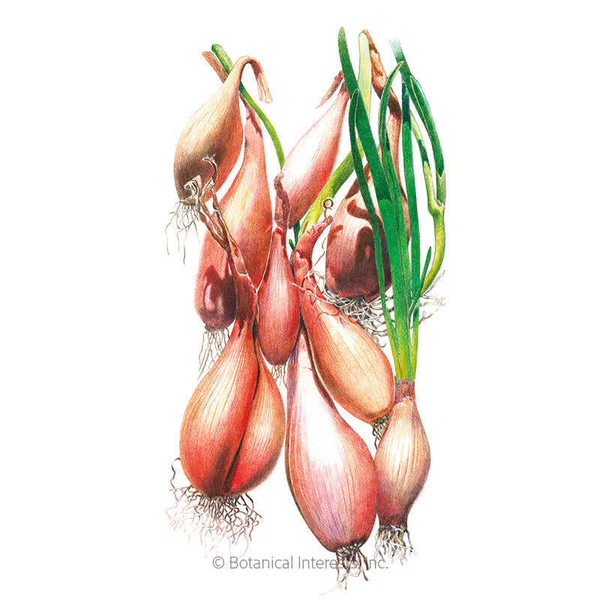
Description
Savor the sweet, mild flavor of this large, easy-to-peel eschalion (banana) type shallot. Very popular with chefs, it is technically a cross between a shallot and an onion. Called Cuisse de Poulet du Poitou (leg of the chicken) in France because it resembles a chicken leg. Enjoy in any dish that calls for onions or shallots. Its lighter flavor delicately enhances fresh preparations, too, like vinaigrettes. Resists bolting, producing well even in warm climates. Recipe inside for shallot vinaigrette.
Variety Info
Days to Maturity: 100 days from transplanting
Family: Alliaceae
Scientific Name: Allium cepa
Type: Eschalion, long-day shallot
Native: Exists only in cultivation
Hardiness: Biennial grown as an annual
Exposure: Full sun
Plant Dimensions: Thick 2” to 6” long torpedo-shaped bulbs
Variety Info: Thick, 2”–6” long, torpedo-shaped bulbs with a copper-colored wrapper and cream-colored interior. ‘Zebrune’ is also called Cuisse de Poulet de Poitou.
Attributes: Frost Tolerant
Sowing Info
When to Sow Outside: 4 to 6 weeks before your average last frost date, or as soon as soil can be worked; when soil temperature is at least 45°F.
When to Start Inside: RECOMMENDED. 10 to 12 weeks before your average last frost date. Transplant outdoors 4 to 6 weeks before your average last frost date. The earlier the start, the bigger the bulb. Ideal soil temperature is 60°–85°F.
Days to Emerge: 7–15 days
Seed Depth: ¼”
Seed Spacing: A group of 2 seeds every 4”
Row Spacing: 12”–16”
Thinning: When 2” tall, thin to 1 every 4”
Growing Info
Harvesting: Shallot bulbs can be harvested at any desirable size. To harvest large bulbs at full maturity, wait until tops have fallen over and turned yellow or brown, they are ready for harvest. Harvest in the morning, lifting the bulbs with a garden fork. Dry them in the garden in the sun for 2 to 3 days, lightly covering the bulbs with straw, or the tops of other onions to prevent sunscald. Cure them for 3 to 7 days in a dry area with good air circulation. Once dry, cut the roots to 1/4”, and the greens to 1” to create a seal, preventing decay.
Notes
Worked somewhat well in the sunnier portions of the Patio Garden, but likely will plant in the City Community Garden in 2026.
This is a long day shallot based on this article: https://www.twopondsfarm.net/blog/storage-onions-and-shallots-for-northern-climates
Action
- task Purchase for the 2026 year ✅ 2025-12-21
When starting these seeds. omit using cells. and just scatter plant in a tray. The roots are relatively easy to split up, and the plant is very forgiving when transplanting.